C2RM… To Know More
Something Awesome Is In The Work
DAYS
HOURS
MINUTES
SECONDS
imtiazahamed219@gmail.com
9903869074
Kolkata, India


Adoni, India
Jamshedpur, India
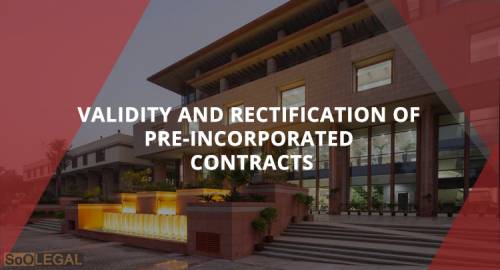
IntroductionThe prime feature of a company is that it is considered a separate legal entity, enabling it to enter into contracts with others and own properties in its name. Since a company is an artificial read more
Introduction
The prime feature of a company is that it is
considered a separate legal entity, enabling it to enter into contracts with
others and own properties in its name. Since a company is an artificial person
who is unborn unless the process of registration is complete, it cannot enter
into any agreement before incorporation. However, more often, the promoter is
obligated to bring the company into legal existence and in order to ensure its
successful running and fulfill his
obligations, on behalf of the prospective company, he may enter into some
contract. Such contract is called 'pre-incorporated contract' or ‘promoter’s contract’. Such contracts are inevitable for the registration of
companies and are therefore also recognized by The Companies
Act,2013 and The
Specific
Relief Act,1963.
Promoter's Liability
During execution, the
promoters enter into the contracts on behalf of the company. Although, the
promoters act as company's agent to represent their interest, the principal is
not in existence while registration. The contracts entered into by the promoters
are therefore not binding on the company or third parties. The validity
and enforceability of pre-incorporation contracts lie in Section15
and Section
19 of The Specific Relief
Act,1963.
Section 15(h) of The Specific Relief
Act,1963 specifies that, where the pre-incorporated contracts are
entered into by promoters for the purpose of the company and subject to terms
of incorporation of the company, the company may ask for specific performance
from the third party.This condition can only be applied if, after
incorporation, the company has expressly demonstrated acceptance of such
contracts, and communicated the same to the third party concerned (i.e. the
other party). Under similar circumstances the other party to the contract under
Section
19(e) of The Specific Relief
Act,1963 may enforce specific performance against the
company.
Accordingly, in order for
the company to enforce the contract against the other party to contract, the
members must ratify the contract followed by a communication of acceptance. The
company may not receive any benefit from such contract unless the contract is
accepted by the company and the promoters would be personally liable for the
contracts.
In the event that the
company does not accept the said contract at its meeting, such contract is
binding on the promoters and the both, promoters and other party may demand
specific performance against each other.
Ratification of the
pre-incorporated contracts
Ratification of contracts by
company is inevitable for the purpose of enforcing it. The promoters can follow
either of the methods stated below for such acceptance or ratification:
1. Accept the contracts by passing a contract
acceptance resolution and the action of promoter for incorporating the company
and related matters.
2.
Novation of contract: Novation of contract is defined in Scarf
v Jardine 1882 7 APP CAS 345 – 198, 371, 431 435 as, ‘being a
contract in existence, some new contract is substituted for it either between
the same parties (for that might be) or different parties, the consideration
mutually being the discharge of the old contract’.
The Company may replace the promoter from the
pre-incorporation contract in the situation of Novation of Contract. Though it
could be said that such a contract would not be called a pre-incorporated
contract, but it should be called a post-incorporation contract; as novation of
contract results in a new contract.
These acceptance acts are necessary after
private company registration, as it possesses a separate legal identity to
operate in its own name. This action would also be beneficial for promoters who
are not personally liable for such a contract entered into for and on behalf of
the company.
Validity of the Pre-incorporated
Contracts
Company is an artificial entity which comes into being after the incorporation process has been completed. Unless a company is born, it cannot execute any contract or be a contracting party. Those contracts entered in name of the company are therefore not valid due to their non-existence. These contracts would be doubtful and enforceability can also be denied. Hence, the promoters are the person who are obliged to promote a company upto operational level to ensure that it is running successfully. The promoters therefore enter into various contracts necessary to promote the company
In the case of insanity, it is presumed that the accused suffered from severe mental instability when the crime was committed, which is why he could possibly not understand the gravity of the crime committed read more
In
the case of insanity, it is presumed that the accused suffered from severe
mental instability when the crime was committed, which is why he could possibly
not understand the gravity of the crime committed by him or her. In a nutshell,
the individual at the time of commission of the offence was not aware of his
actions due to the unsoundness of mind
or any other mental issue.
Insanity
can be broadly categorized as “Medical
Insanity” and “Legal Insanity”. An
individual cannot be acquitted merely on the basis of ‘Medical Insanity’ and‘Legal
Insanity’ must be proved to establish that the individual had no reasonable
knowledge of the act he/she has
committed and its repercussions. The maxim ' actus non facet ream nisi men's
sit rea ' implies that the physical act does not make a
person guilty by itself, the mental component in the form of evil intent is
equally important.
Introduction
Modern
criminal law is based on the belief that individuals are morally responsible
beings and are not considered the agents that cause harm. To be held
criminally responsible, two essential elements must be proven, beyond
reasonable doubt,
a. The person committed the act (actus reus)
b. In doing so, the person acted knowingly
and for rational reasons (mens rea) with his or her own free will.
Section-84
, the Indian Penal Code, 1860 (IPC) sets out the legal
liability standard in cases of alleged crime committed by a person with mental
illness. The IPC does not have a concept of "unsoundness of mind."
Nevertheless, the courts have interpreted this term primarily as being analogous
to insanity. But the word ‘insanity’
itself has no accurate definition. The term ‘insanity’holds
different meanings in different ways and defines varying degrees of mental
disorders. Anyone who has a mental illness is not ipso facto excluded from
criminal responsibility. There needs to be a distinction between legal insanity
and medical insanity.
Historical Application
Though
in the last three centuries the insanity defense has taken on a legal position,
it has been in practice for decades. Various tests were used to classify a
person to be legally insane, such as the Wild Beast Test, The Insane
Insanity Test, and the Ability test to differentiate between right and wrong.
These three experiments laid the foundation for the Mc Naughten landmark
statute. The Mc Naughten statute became a groundbreaking precedent to the
insanity defense rules. Section 84 of the IPC (Indian Penal Code) is based
exclusively on the McNaughten rules. The
said rule follows the below mentioned principle,
"Every
man is to be presumed to be sane, and ... that to establish a defense on the
ground of insanity, it must be clearly proved that, at the time of the
committing of the act, the party accused was laboring under such a defect of
reason, from disease of mind, and not to know the nature and quality of the act
he was doing; or if he did know it, that he did not know he was doing what was
wrong."
In
the landmark ruling of Surendra Mishra vs. State of Jharkhand (2011) 11 SCC 495, the
Apex Court claimed that an accused seeking immunity from responsibility for an
act under section 84 of the IPC has to prove legal insanity. It was also
stated that the word "unsoundness of mind" is not specified in the
IPC and hence viewed primarily as equivalent to insanity. In its judgment, the
Apex Court found that although the accused suffered from certain mental
instability both before and after the accident, it was not possible to
infer from that due to the instability of mind the appellant did not know
the essence of his conduct at the time of the commission of the offense; that
he was either incorrect or contrary to the statute, and therefore denied insanity
defense.
Further,
the Supreme Court in the case of Chellathurai vs The State of Madras
C.P.O./T.C./I.S./D.O.No. 10/2009 has stated that the crucial time at
which the instability or unsoundness of mind must be proved is the time when
the crime is actually being committed and burden of proof of the same lies on
the appellant to claim the defense. Under Section 84 IPC, mere abnormality
of a mind or partial illusion, irresistible compulsion or compulsive behavior
offers no defense.
The
main purpose of the provision is fulfilled by psychiatrists who assist the
court in determining whether certain mental illness or instability would affect
an individual’s ability to decide what he is doing is either right or wrong or
is contrary to the law.
Recent scenario and its
criticism
In
the recent scenario, the 2012 Nirbhaya gang rape and murder case i.e.
Mukesh & Anr v State of NCT of Delhi S.L.P. (Criminal) Nos. 3119-3120 of
2014 which is still to be
decided even though several death warrants were initiated but due to some or
other reasons the execution order gets delayed. The counsel for the accused
Vinay Sharma contented that Vinay has been continuously tortured in jail and
due to that he is getting mentally unstable. Although the contention was denied
by the court.
The
defense by insanity is heavily criticized because of the fact that under this
defense the court does not need to check whether the offence has been committed
or not but has to determine the mens rea
of the accused which is very complicated. Determining the mentality of the
accused at the commission of the crime is a very complicated as one is judged
by his acts and it is very difficult to establish someone’s intention on as the
sole basis for defense to be granted.
In
the case of insanity, it is presumed that the accused suffered from severe
mental instability when the crime was committed, which is why he could possibly
not understand the gravity of the crime committed by him or her. In a nutshell,
the individual at the time of commission of the offence was not aware of his
actions due to the unsoundness of mind
or any other mental issue.
Insanity
can be broadly categorized as “Medical
Insanity” and “Legal Insanity”. An
individual cannot be acquitted merely on the basis of ‘Medical Insanity’ and‘Legal
Insanity’ must be proved to establish that the individual had no reasonable
knowledge of the act he/she has
committed and its repercussions. The maxim ' actus non facet ream nisi men's
sit rea ' implies that the physical act does not make a
person guilty by itself, the mental component in the form of evil intent is
equally important.
Introduction
Modern
criminal law is based on the belief that individuals are morally responsible
beings and are not considered the agents that cause harm. To be held
criminally responsible, two essential elements must be proven, beyond
reasonable doubt,
a. The person committed the act (actus reus)
b. In doing so, the person acted knowingly
and for rational reasons (mens rea) with his or her own free will.
Section-84
, the Indian Penal Code, 1860 (IPC) sets out the legal
liability standard in cases of alleged crime committed by a person with mental
illness. The IPC does not have a concept of "unsoundness of mind."
Nevertheless, the courts have interpreted this term primarily as being analogous
to insanity. But the word ‘insanity’
itself has no accurate definition. The term ‘insanity’holds
different meanings in different ways and defines varying degrees of mental
disorders. Anyone who has a mental illness is not ipso facto excluded from
criminal responsibility. There needs to be a distinction between legal insanity
and medical insanity.
Historical Application
Though
in the last three centuries the insanity defense has taken on a legal position,
it has been in practice for decades. Various tests were used to classify a
person to be legally insane, such as the Wild Beast Test, The Insane
Insanity Test, and the Ability test to differentiate between right and wrong.
These three experiments laid the foundation for the Mc Naughten landmark
statute. The Mc Naughten statute became a groundbreaking precedent to the
insanity defense rules. Section 84 of the IPC (Indian Penal Code) is based
exclusively on the McNaughten rules. The
said rule follows the below mentioned principle,
"Every
man is to be presumed to be sane, and ... that to establish a defense on the
ground of insanity, it must be clearly proved that, at the time of the
committing of the act, the party accused was laboring under such a defect of
reason, from disease of mind, and not to know the nature and quality of the act
he was doing; or if he did know it, that he did not know he was doing what was
wrong."
In
the landmark ruling of Surendra Mishra vs. State of Jharkhand (2011) 11 SCC 495, the
Apex Court claimed that an accused seeking immunity from responsibility for an
act under section 84 of the IPC has to prove legal insanity. It was also
stated that the word "unsoundness of mind" is not specified in the
IPC and hence viewed primarily as equivalent to insanity. In its judgment, the
Apex Court found that although the accused suffered from certain mental
instability both before and after the accident, it was not possible to
infer from that due to the instability of mind the appellant did not know
the essence of his conduct at the time of the commission of the offense; that
he was either incorrect or contrary to the statute, and therefore denied insanity
defense.
Further,
the Supreme Court in the case of Chellathurai vs The State of Madras
C.P.O./T.C./I.S./D.O.No. 10/2009 has stated that the crucial time at
which the instability or unsoundness of mind must be proved is the time when
the crime is actually being committed and burden of proof of the same lies on
the appellant to claim the defense. Under Section 84 IPC, mere abnormality
of a mind or partial illusion, irresistible compulsion or compulsive behavior
offers no defense.
The
main purpose of the provision is fulfilled by psychiatrists who assist the
court in determining whether certain mental illness or instability would affect
an individual’s ability to decide what he is doing is either right or wrong or
is contrary to the law.
Recent scenario and its
criticism
In
the recent scenario, the 2012 Nirbhaya gang rape and murder case i.e.
Mukesh & Anr v State of NCT of Delhi S.L.P. (Criminal) Nos. 3119-3120 of
2014 which is still to be
decided even though several death warrants were initiated but due to some or
other reasons the execution order gets delayed. The counsel for the accused
Vinay Sharma contented that Vinay has been continuously tortured in jail and
due to that he is getting mentally unstable. Although the contention was denied
by the court.
The
defense by insanity is heavily criticized because of the fact that under this
defense the court does not need to check whether the offence has been committed
or not but has to determine the mens rea
of the accused which is very complicated. Determining the mentality of the
accused at the commission of the crime is a very complicated as one is judged
by his acts and it is very difficult to establish someone’s intention on as the
sole basis for defense to be granted.
IntroductionThere are certain cases where the relationship between a landlord and tenant takes a different turn and the landlord has every determinant from the rented property. The rent laws in India, read more
Introduction
There are certain cases
where the relationship between a landlord and tenant takes a different turn and
the landlord has every determinant from the rented property. The rent laws in
India, however, tend to favor tenants and secure their landlords' privilege.
The guide addresses the legal remedies available to landlords for lawfully
evicting a tenant under The Haryana Urban (Control of Rent and Eviction) Act,
1973(hereinafter called “The Act”).
Grounds
of Eviction
Section -13(2)(i)
Arrears of rent
The tenant may be
ejected from the premises where the rent due to him has not been paid or
tendered by him within fifteen days of the expiry of the time fixed in the
tenancy agreement with his landlord or in the absence of any such agreement by
the last day of the month following that for which the rent is due.
Supreme court in the
case, Ladu Ram v. Ganesh Lal, 1999(2) RCR 220 (SC) states that the landlord must allege and prove three requirements, namely:
1. the tenant is in arrears of rent
2. such arrears of rent have been due
for more than six months
3.
the tenant has failed to pay the landlord such
arrears of rent.
With the exception of
these requirements, there is no other legal requirement that a landlord should
plead and prove to obtain an eviction decree.
Section-13(2)(ii)(a)
Sub-letting
Where after the
commencement of this Act, the tenant has without the written consent of the
landlord, transferred his right under the lease or sublets the entire building
or rented land or any portion thereof, he shall be liable for ejection.
The initial onus of
proving subletting lies with the landlord, but when a third person is in
possession, it must not be inferred that this is a subletting case.
In the case of
Associated Hotels of India Ltd., Delhi v. S.B.Sardar Ranjit Singh AIR 1968 SC
933, the Supreme Court held that
when eviction on the ground of subletting is sought, it is the landlord's
responsibility to prove subletting. Therefore, it was held that if the landlord
prima facie demonstrates that the third party is solely in possession of the
premises for valuable consideration, it would then be for the tenant to rebut
the evidence.
Section-13(2)(ii)(b)
Change of user
On analyzing this
clause, it seems plain that the pride of place for its interpretation must
first obviously go to "used the
building or rented land for a purpose other than that for which it was leased.”
In Mehta Baldev Dutt v. Puran Singh (1980) 1 Ren CR 130, it was held
that where premises were originally leased for a specific purpose, any
subsequent use thereof that is part of, or ancillary to, the aforementioned
purpose would not amount to a user change within the meaning of S. 13 (2) (ii)
(b) of the act.
The Hon'ble Supreme
Court in Bharat Lal Baranwal v. Virendra Kumar Aggarwal 2003(1)
Rent Control Reporter 178 said that when the premises were let out for
selling copies and books, the installation of printing press amounted to change
of user.
Section- 13(2)(iii)
Material impairment
Material impairment are intended to change the substantial nature
of the building's form and character.
"A
landlord, in order to be entitled to the grant of permission to terminate the
tenancy, is required not only to prove an act of waste on the part of the
tenant but also to prove that the said act is likely to impair materially the
value or the utility of the house," Smt.
Savitri Devi v. U.S. Bajpai AIR 1956 Nagpur 60
and Charan
Singh v. Shrimati Ananthi & others (1966) 6 PLR 780 .
"Mere construction
of a false roof which is only wooden or the setting of a wooden stair or making
of a few holes in the roof for letting out the smoke from the hotel, cannot be
held to be such material alterations which may result in changing the character
or nature of the premises. " Shri Anup Chand & others v. Shri Trilok
Singh (1977) I RCJ 752.
Section-
13(2)(iv) Nuisance
In the case Dr.Lakhi
Ram v. Girdhari Lal and another, 2006(1) L.A.R. 417 (P&H), Shop was
initially given on rent for running a clinic. Petitioner set up a PCO / STD
booth on the road, many customers started to visit the same booth, which has
resulted into causing nuisance to the landlords. Hence tenant is liable to
eviction.
Section-
13(2)(v) Cease to occupy
In the case Ram
Lok v. Tarloki Nath, 2000(2) PLR 713, the premises of the suit were locked up for a year and two months. The
occupant had not only surrendered his sales tax number, which is a clear
indication that he does not do business. To crown it all, the tenant, who
claims to be doing business at the suit premises, has not produced any account
book document to show that any business was actually transacted from the suit
premises. These findings clearly show that the petitioner had been proven not
to be carrying on any business in the suit property and, in fact, had ceased to
occupy the premises for the relevant period. Eviction order is upheld.
The Sexual Harassment Act, 2013 Cannot be a weapon for claims of misconduct or non-existent allegations: Madras High CourtCase:Union of India v. Reema Srinivasan Iyengar. Brief facts: In the present case, read more
The
Sexual Harassment Act, 2013 Cannot be a weapon for claims of misconduct or
non-existent allegations: Madras High Court
Case:
Union of India v. Reema
Srinivasan Iyengar.
Brief facts:
In the present case, the
plaintiff Mr. V.Natarajan was deputy registrar of Trade Mark and GI, in Chennai
and the respondent is Mrs. Rema Srinivasan Iyengar, assistant registrar, whom
the court referred to in the judgment as the claimant.
On 02. 12. 2013, the respondent lodged a
complaint against the petitioner with the Registrar and Controller General of
Trade Marks and GI and Patents and Design, complaining about the petitioner's
high-hardness and arrogant behavior that hurt her self-respect. The Registrar
and Controller General had formed an independent commission on workplace sexual
harassment.
On 30.06.2015, the
complainant preferred another complaint in which she narrated many instances of
the petitioner's rude behaviour, and she mentioned the word "sexual
harassment" in the complaint. She wrote the letter to the Tamil Nadu State
Commission of Women, expressing her apprehension that the internal committee
will not be able to render justice to her, since all those who are part of the
committee are subordinate to the petitioner. Hence, her petition should be
referred to the local comittee.
Accordingly, the Local
Committee was appointed by the Social Welfare Department (Tamil Nadu
Government). Meanwhile the complainant's complaints to the internal committee,
are posed by taking into account. On 22.12.2015 Smt. Sunita Yadav Director,
Department of Industrial Policy and Promotion, Ministry of Commerce and
Industry has been appointed as chairperson of the vide letter of the internal
committee.
On 30. 12. 2015, the
complainant's letter had been forwarded to the Trade Marks Controller General
to expedite the inquiry. According to a letter of 25.02.2016 intimating the
prosecution process, it was found that the case was made pursuant to section
3(2)(iii)(iv)(v) of the Sexual Harassment of Women at Workplace Act, 2013.
On 28.04.2016, the
complainant responded to the Board of District Social Welfare that two
simultaneous trials could not be viewed as legally valid. The plaintiff
even objected to the new internal committee according to the letter dated
16.11.2016. Because according to the complainant, even if the chairperson is
changed, all other members remain the same. So she approached the Central
Administrative Tribunal, Madras Bench to declare the internal committee's
constitution void. The CAT, madras bench, held that a preliminary inquiry had
already been conducted by the Local Committee and that the internal committee
established by the employer is against the law because the petitioner himself
is head of the department and therefore the complaint against the petitioner
should be inquired by the local committee.
The
complainant who has been dismissed by the Central Administrative Tribunal,
Madras Bench, preferred the appeal. The petitioner thus filed a petition in
writing against CAT's order, Madras Bench.
Issues:
1)
Whether the preliminary investigation
can be carried out in conjunction by the ICC and the local committee?
2)
Whether the findings of the Local
Committee which is ex parte need to be complied with?
3)
Whether the original complaint in
December 2013 prompted the establishment of a committee to investigate women's
sexual harassment in the workplace?
4)
In the strictest sense, whether the
person charged was an employer?
Arguments of the
petitioner:
·
The plaintiff argued that the defendant
was an assistant registrar in a quasi-judicial role and that it was not
possible to intervene with her decision making. The complainant was the head of
the Chennai office but was subordinate to his New Delhi Superiors and therefore
not an employer, and that both the first and second grievances were sent to the
New Delhi Registrar and Controller General.
·
The petitioner also claimed that the
Registrar and Controller General should not have formed an Internal Committee
to investigate sexual harassment complaints in the first place for a generic
case with no accusation of sexual harassment in it. The Superiors in the
Department could have remedied the complaint.
·
The plaintiff further argued that the
complainant's complaint concerning the members of the Internal Committee had
been acknowledged by the employer and that a senior lady officer had been made
the chairperson Which only demonstrates the employer's bonafide motive and
that, instead of respecting the superior officer, the claimant went ahead with
an unwarranted petition to the Local Committee. Consequently it should be set
aside.
Arguments
of the complainant:
·
The complainant's learned counsel called
the court's attention to section 2(g) of the 2013 Employer's Sexual Harassment
of Women at Workplace (Prevention, Prohibition and Redressal) Act. It was the
complainant's contention that since the petitioner was Department Office
Administrative Head at Chennai, he must be considered as an employer under the
Act.
·
It was further argued that Section 6 of
the Act grants the local committee jurisdiction. Local committee is thus the
sole authority to attempt this case.
Judgment:
The
Court held that the enquiry should not be retrospective under the Sexual
Harassment of Women at Workplace (Prevention, Prohibition and Redressal) Act,
2013 ("The Act"), and the accused must be given the opportunity to
defend themselves.
The
Madras High court further noted :
“At
the same time, the Sexual Harassment of Women at Workplace (Prevention,
Prohibition and Redressal) Act, 2013 also brought in two provisions in order
not to deter women from filing complaints. One was that their inability to
prove a complaint will not render it false. Secondly, the malicious intent has
to be specifically established before disciplinary action is recommended
against the complainant.”
The
court held the Local Committee's findings unconstitutional, and ruled that the
complainant was not the employer. It further mentioned that "This letter
fits in with the concept of a complaint of sexual harassment and contains all
the ingredients necessary to evaluate an offense
“The Act”. However, it lacks
details of the alleged incidents.”
Section
3(2) of the Act was examined and held to be “a solitary allegation of intemperate
language against a female employee does not constitute an offense under the
Act”.
It
further commented that: “The complainant,
it appears, made a futile attempt to settle her personal score with the
petitioner. Every office has to maintain certain decorum and women employees
cannot be allowed to go scot-free without completing their assignments. The
Administrative Head or the Chief has every right to extract work and he or she
has his or her own discretion and prerogatives. If a woman employee is
discriminated against due to her inefficiency or for any other official
reasons, the recourse for her is not the one taken by this complainant.”
It is not appropriate
for women to exploit the Act to threaten someone with false or non-existent
claims.
Aligarh Development Authority Vs. Megh Singh & Ors FACTS The appealing party Aligarh Development Authority took steps for obtaining a land which has been acquired by the respondent No.1 according read more
Aligarh
Development Authority Vs. Megh Singh & Ors
FACTS
The appealing
party Aligarh Development Authority took steps for obtaining a land which has
been acquired by the respondent No.1 according to Notification gave under
Section 4(1) of the Land Acquisition Act, 1894
on 09.08.2004. At the same time emergency statement was also invoked
under the arrangements of Section 17 followed by Section 6 revelation dated
03.08.2005. As per the appealing party ownership of the land was taken and some
portion of the pay was stored with the Special Land Acquisition Officer. The
respondent No.1 challenged the acquisition on different grounds and the High
Court of Judicature at Allahabad by the upbraided Judgment dated 21.10.2010
permitted the writ request and subdued the Notification dated 09.08.2004 and
the assertion dated 03.08.2005. Among different reasons, the main purpose
behind taking such a view is, that after invoking emergency statement, no award
was passed considerably after the expiry of four years.
Thus aggrieved,
the Requisitioning Authority - Aligarh Development Authority is before this
Court. When the matter was pending before this Court, the land owner
non-applicant filed I.A.No.3/2015 contending that respondent No.1 is entitled
to a declaration that acquisition proceedings have lapsed in view of the
operation of Section 24 of the Right to Fair Compensation and Transparency in
Land Acquisition, Rehabilitation and Resettlement Act, 2013 (For short '2013
Act'), since neither compensation has been paid to the owner nor possession has
been taken by the Land Acquisition Collector. The Appellant Authority has filed
reply to the affidavit that the remuneration has been kept with the Land
Acquisition Collector. Most definitely, it is expressed in the affidavit that
the land has just been taken under position and a 'full - fledged and finish
private settlement has been created'. It is anyway a conceded position that no
Award either under the 1894 Act or under the 2013 Act has been passed in regard
of the place where there is respondent No.1
SECTION
24 OF LAND ACQUISITION ACT 2013
:
Section 24 of the 2013
Act envisages mainly two situations;
i) where the land acquisition proceedings had
already been initiated under the 1894 Act but no award was passed till the date
the new Act came into force.
(ii) where the Award has been passed but neither
the owner has been dispossessed nor has he been paid the compensation.
Under the first, where
the award had not been passed, the acquisition proceedings could continue; but
the compensation will have to be determined under the scheme of 2013 Act. Under
the second category, there is a statutory lapse of the proceedings. There is
also an incidental third situation, where award under the 1894 Act had already
been passed prior to coming into force of the 2013 Act, but payment is yet to
be made and possession is yet to be taken. In that case, the further
proceedings after the award could continue under the old Act of 1894; but if
either payment or possession has not taken effect in five years prior to the
2013 Act, then proceedings will lapse.
JUDGEMENT
For the above situation,
since as a matter of fact the compensation has not been passed, there emerges
no question of lapse. The land obtaining procedures would proceed however with
the rider that the compensation should be passed and pay decided under the
arrangements of 2013 Act. The appellant and the Acquisitioning Authority are
coordinated to finish the acquisition procedures by passing compensation under
the provisions of the 2013 Act. This will be done within a period half year and
unnecessary likewise to state that the whole award due to respondent No.1 would
be determined under the provision 2013 Act and the same will either be saved
with the Land Acquisition Collector or dispensed to the respondent No.1 within
one month from there on.
Issue: Current case questions the Hon’ble Calcutta High Court judgment whereby the Appellant was convicted under Section-302 read with Section-34 and Section-201 read with Section-34 of the Indian Penal read more
Issue:
Current case questions the Hon’ble Calcutta High Court judgment whereby the
Appellant was convicted under Section-302 read with Section-34
and Section-201
read with Section-34 of the Indian Penal Code, 1860.
Background/Facts: A
phone call was received by Rajarhat Police Station, stating that a dead body
has been found inside a well. The body
was taken out the next morning as when the officers reached the site, it was
dark. After the post-mortem of the dead body, it was concluded that the
deceased died because of strangulation as the larynx
and trachea were highly congested and the body was also partially decomposed.
As the investigation started, the apparels/clothes on the body
were seized, photographs were taken of the body and the subsequently the body
was cremated shortly as it was in a decomposed state. It was later identified
that the body was of Becharam Dhara who was reported missing by his mother.
On information received in the investigation process the Appellant
was arrested. Pursuant to the confession made by the Appellant, an Anglo-Swiss
watch was seized from A.C. Watch Company.
Prosecution contends that the watch belongs to the brother of the deceased
i.e. Kenaram Dhara. He stated that he gave his watch to the deceased when he
left the house.
As the investigation completed, the Appellant along with three
others were charged with committing the murder of Becharam Dhara and concealing
the body.
Various submissions were given in the trial court (hereinafter referred to as “the court”),
the sister of the deceased submitted that the deceased left the house by
telling her that he was going to visit the Appellant. Similarly, a
relative of the deceased deposed that the deceased visited her house in the
morning and left around afternoon informing her that he was going to meet the
Appellant. It was also contended that the deceased and the Appellant were
friends. On the basis of the evidence on record, the court concluded that there
was sufficient evidence to show the Appellant's guilt.
According to the proprietor of the A.C. Watch Company, the
Appellant gave a watch for repair one day before the body of the deceased was
found. Recovery of the watch which belonged to the deceased’s brother and which
was eventually given to the deceased while he was leaving home was taken as a
circumstance to prove the involvement of the Appellant in the crime. The
Appellant gave the watch to be repaired. The Appellant did not deny
that the signature on the counterfoil of the receipt taken from
the owner of the shop was his. He merely stated that the police had taken the
signature illegally during the investigation. On the basis of that evidence,
the Court concluded that the Appellant was guilty of the murder of
Becharam Dhara. Upon reassessing the facts on record, the High Court upheld the
conviction.
Furthermore, during the trial, the deceased’s brother told the
court that one day before the body was discovered he saw the Appellant in a
bus. When the Appellant saw him, he started trembling and alighted the bus one
stop ahead of Baguihati (the original destination).
The
Appellant's conviction is mainly based on the recovery of the watch which had
been handed down to the deceased pursuant to the Appellant's confessional
statement. The receipt given by the owner of the shop was confiscated
from the appellant during the course of the investigation, according to
the prosecution. His confessional statement was recorded on the basis of which
the receipt was taken from his house. The watch was subsequently confiscated
from the shop along with the counterfoil of the receipt on which the
applicant's signature was found. The defense contends that the Appellant was
compelled by the police to sign the counterfoil. It was also claimed that the
receipt had not been taken from the Appellant's house. Also, the evidences on
which the conviction is based are circumstantial and not direct.
Observations by the Supreme Court:
On
an overall analysis of the recorded evidence, in particular the evidence
provided by the family of the deceased would not lead us to believe that the
appellant and the deceased were last seen together. That evidence only shows
that the deceased had informed them that he would visit the Appellant. There is
no recorded evidence to show that the last time the Appellant was seen was with
the deceased. The facts of the case do not conform to section-106 of the Indian
Evidence Act, 1872. The Appellant cannot be said to have failed to
explain what happened after they were last seen together, especially when there
is no evidence to show that they were last seen together.
A
close examination of the recorded material would show that the circumstances on
which the prosecution relied to prove the Appellant's guilt were not complete,
and would not lead to the conclusion that the Appellant must have committed the
murder in all likelihood. Therefore, setting the conviction aside and acquitting
the Appellant from all charges.
What does Brexit mean? British exit- refers to UK leaving the EU.What is European Union means?The European Union (EU) is a political and economic union that comprises 28 read more
What does
Brexit mean?
British exit- refers to UK leaving the EU.
What is European Union means?
The European Union (EU)
is a political and economic union that comprises 28 European countries. This
allows free trade, meaning goods can travel between member countries without
any checks or additional fees. The EU also enables free movement of people,
wherever they choose to live and work in.
The United Kingdom
joined in 1973 (when it became known as the European Economic Community) and
will be the first to leave.
The United Kingdom (UK)
officially left the EU on 31 January 2020. While it has settled on the terms of
its exit from the EU, both parties still have to discuss how their future
relationship will look.
This will have to be
sorted out during the transition period (which some prefer to call the
implementation period), which started immediately after the day of Brexit and
is due to end on 31 December 2020. The UK will continue to follow all of the
EU's regulations during this 11-month period and its trade relationship will
remain the same.
The transition period
is meant to give some breathing space to both sides while negotiating a new
free trade agreement. This is important because at the end of the transition,
Britain will be leaving the Single Market and Customs Union. A free trade
agreement would allow goods to travel around the EU with no checks or
additional fees. If a new one cannot be negotiated in time, then the UK will
face the prospect of having trade with no deal in place. That would mean
tariffs (taxes) on UK goods travelling to the EU and other trade barriers.
What
is the Brexit deal?
Apart from trade, many
other aspects of the future relationship between the UK and the EU will need to
be discussed as well. For example:
§
Law enforcement, data sharing and
security
§
Aviation standards and safety
§
Access to fishing waters
§
Supplies of electricity and gas
§
Licensing and regulation of
medicines
Prime Minister Boris
Johnson maintains that the transition period will not be prolonged, but the
European Commission has warned that the timeline would prove to be extremely
difficult.
The transition period
and other aspects of UK leaving were decided upon in an agreement called the
withdrawal agreement. Most of that has been decided by the Government of
Theresa May. Yet he made some changes to it after Mr Johnson replaced her in
July 2019.
The key change is that
a customs border between Northern Ireland and Great Britain will be effectively
created under Mr Johnson's proposal. Some goods from Great Britain which enter
Northern Ireland will be subject to checks and will have to pay EU import taxes
(called tariffs). When goods stay in Northern Ireland (i.e. are not transported
to the Republic of Ireland), these would be refunded.
Conclusion
Brexit gives the United
Kingdom’s economy the golden opportunity to revive on the back of a
re-balancing away from the EU and export its way round the world. This means
the United Kingdom will be able to take advantage of the grand horizons to
broaden its export markets while developing new supply chains and production
networks, particularly within the Commonwealth context.
Post-Brexit, in an
increasingly unpredictable and turbulent world, the UK can be a regional and
Commonwealth member as well as a powerful and loyal partner of the EU.
The essence of a trademark is that, it can be uniquely identified by a purchaser in the market. Also, a trademark carries a whole lot of attributes, most important being the goodwill it has earned over read more
The
essence of a trademark is that, it can be uniquely identified by a purchaser in
the market. Also, a trademark carries a whole lot of attributes, most important
being the goodwill it has earned over a period of time. When can it be said that
a trademark is deceptively similar to another and what effect does it has on
the party whose trademark is violated.
Issue:
Whether the Sardarbuksh trademark is deceptively similar to the Starbucks
trademark phonetically or visually.
A Suit
was brought in by Starbucks alleging Sardarbuksh of copying their
company name as well as their logo, which is too close to their famous 2-tailed
mermaid, and for illegal use in the promotion of their product.
Sardarbuksh
has opened five coffee shops in Delhi, offering a wide menu of coffee, shakes
and snacks. They were accused of copying a similar name as well as a very
similar logo to that of the US global Starbucks coffee chain.
Background: Starbucks
registered their trademark which consisted of a word mark i.e. STARBUCKS and a logo
depicting “crowned maiden with long
hair” in India in 2001. The defendants began their business in 2015 by
calling their enterprise "Sardarbuksh
Coffee & Co" where "Sardar"
is a Hindi word meaning "Commander"
and "Buksh" is a Hindi
word meaning "Pardon." In
May 2018, the defendants formed a private limited company with the name
"Sardar Buksh Private Limited" and have been operating under that
name since. The goods and services rendered by both the plaintiff and the
defendant are the same. The defendants used a logo consisting of a circular
black band with the words 'SARDARBUKSH
COFFEE & CO.' and a turban Commander along with wavy lines
extending from the edges.
In 2017, Starbucks asked the defendants to change
their logo by way of a letter of demand. Further, it was modified to a color
scheme of black and yellow and operations were commenced with the newly
modified logo.
Eventually, Starbucks filed a suit against Sardarbuksh
in the Hon’ble Delhi High Court (hereinafter
referred to as “the Court”). The legal perspective was the deceptively
similar analogy which is derived from Section 2(1)(h) read in Section
11 of The Trademarks Act, 1999 that states that, when two marks are
put next to each other, if they cause confusion or mislead the viewers, they
would be deceptively similar and therefore cannot be registered.
Observations:
According to previous judgments there were
various tests that were determined by courts to prove the deceptively similar
analogy, such as test of likelihood and confusion, goodwill etc. In the case of National Sewing Thread Co. Ltd.
vs. James Chadwick and Bros AIR 1953 SC 357 it was held that “the controversy of deceptively similar can
only be decided by stepping in the shoes of purchaser, who is considered to be
a man with ordinary intelligence. If the identification of two brands causes
confusion to the purchaser then it would be right to say they are deceptively
similar”.
Further, the fact that both the parties are
dealing in same kind of trade and offering same services to its customers, also
plays an important role. In the case of M/s Nandhini Delux v. M/s Karnataka
Co-operative Milk Producers Federation Ltd. CIVIL APPEAL NO. 2943-2944 OF 2018 it was held that, due to difference in the
variety of products traded and difference in visuals of both companies the trademarks
‘NANDINI and NANDHINI’ will be
considered to be non-infringing.
Besides the legal aspect of the present case, the
marks being deceptively similar would also have certain economic complications on
the plaintiff. Starbucks is a global brand having goodwill that has been
amassed over a long period of time. Here, it can be said that the defendant had
the knowledge of the global reputation that Starbucks has and further wanted to
exploit that image to get market attention rapidly.
On 1st August, 2018 the decision was
given by the Court in favor of Starbucks and further it ordered the defendants
to modify their store name from “Sardarbuksh
Coffee & Co.” to “Sardarji-Bakhsh
Coffee & Co.”. The order for modification was given to the 20 stores
that have not yet opened. The court also permitted to use the name “Sardarbuksh Coffee & Co.” for the
previously operating two stores.
On 27th September 2018, it was also
agreed that the defendant would change the name of all its outlets to "Sardarji-Bakhsh Coffee & Co."
In addition, it was explained and decided that, if a third party uses the term
"Bakhsh", then the
defendant would have the right to bring an action against such a violator. The
suit was settled on those terms.
IntroductionIndian roads are known to be one of the worlds most dangerous. Uncertain road conditions including sharp curves, potholes and steep grades have proved to be very deadly. During 2017, according read more
Introduction
Indian roads are known to be one of the worlds most dangerous. Uncertain road conditions including sharp curves, potholes and steep grades have proved to be very deadly. During 2017, according to data of the Ministry of Transport and Roads (MTR), potholes cost 3,597 lives. This is an increase of 55% compared to 2016. Almost 10 people per day die in the country due to faulty roads or poor maintenance. The need to make road designers and engineering agencies increasingly accountable is long overdue.
Now,
under section-198A of the Motor Vehicle (Amendment) Act 2019
(hereinafter referred to as “the Act”),
this crucial issue has been genuinely addressed. This section ensures that
mistakes shall be punished legally for failure to meet road design,
construction and maintenance requirements.
Objective of the
Amendment
On
September 1, 2019, the Motor Vehicles (Amendment) Act 2019 came into force with
an aim to curb road accidents in India and improve road safety. This major
change to the Motor Vehicles Act 1988 has resulted in the implementation of
fresh fines and vehicle licensing requirements along with revised operating
standards for both personal and commercial vehicles.
The
new Motor Vehicles Bill is causing a jaw-dropping increase in fines for
violators of traffic rules. The Bill also seeks to spread information
about road safety and to prevent drivers from flouting traffic rules and
regulations.
The
increased fines levied by the Act have been a subject of widespread concern.
Several people have expressed disappointment at updated sanctions, deemed them
a move that could allow for more corruption. It is however necessary noting, human intervention is to be effectively reduced by strategic technology
incorporation with enforced compliance, thereby reducing the impact of such
practice.
Some
states like Maharashtra, Delhi and Karnataka have also started installing
high-resolution cameras at traffic junctions to automatically monitor and send
violation feeds to control centre's.
Changes
in the Act
Under
the Act, traffic violations such as drunken driving draw a fine of Rs.
10,000/-and/or 6 months to 2 years imprisonment. Penalties for driving without
a license have been raised from "fine to Rs.500/- and/or imprisonment that
may stretch to 3 months" to "fine of Rs. 5,000/- and/or imprisonment
for up to 3 months". Not wearing a helmet while riding a
two-wheeler can now cause you to pay Rs 1,000/- fine and 3-month
banning of license.
Violations
such as speeding, not using a helmet, not using a seat belt, not using a child
safety device and distracted driving are established killers on our roadways.
The act multiplies the fines by 10 times for speeding (section
189), non usage of helmets (section 194D), and the non usage of
seat belts and/or child protection devices (section 194B), among other clauses
such as stricter penalties for drunken driving (section 185) and dangerous
driving (section 184) with possible imprisonment. Through these provisions, not
only does the Act aims to protect road users from risk factors, but also aims
to deter the practice of negligence by road users in order to avoid further
loss of life.

Allahabad, India

Kolkata, India

Allahabad, India

Moradabad, India

Mohali, India

Navi Mumbai, India

Glendale, United States

Muzaffarpur, India
DAYS
HOURS
MINUTES
SECONDS
In adherence to the rules and regulations of Bar Council of India, this website has been designed only for the purposes of circulation of information and not for the purpose of advertising.
Your use of SoOLEGAL service is completely at your own risk. Readers and Subscribers should seek proper advice from an expert before acting on the information mentioned herein. The content on this website is general information and none of the information contained on the website is in the nature of a legal opinion or otherwise amounts to any legal advice. User is requested to use his or her judgment and exchange of any such information shall be solely at the user’s risk.
SoOLEGAL does not take responsibility for actions of any member registered on the site and is not accountable for any decision taken by the reader on the basis of information/commitment provided by the registered member(s).By clicking on ‘ENTER’, the visitor acknowledges that the information provided in the website (a) does not amount to advertising or solicitation and (b) is meant only for his/her understanding about our activities and who we are.

Resource centre is one stop destination for users who are seeking for latest updates and information related to the law. takes the privilege to bring every single legal resource to your knowledge in a hassle free way. Legal Content in resource centre to help you understand your case, legal requirements. More than 3000 Documents are available for Reading and Download which are listed in below categories:
SoOLEGAL Transaction Services Agreement :
By registering yourself with SoOLEGAL, it is understood and agreed by you that the Terms and Conditions under the Transaction Services Terms shall be binding on you at all times during the period of registration and notwithstanding cessation of your registration with SoOLEGAL certain Terms and Conditions shall survive.
"Your Transaction" means any Transaction of Documents/ Advices(s), advice and/ or solution in the form of any written communication to your Client made by you arising out of any advice/ solution sought from you through the SoOLEGAL Site.
Transacting on SoOLEGAL Service Terms:
The SoOLEGAL Payment System Service ("Transacting on SoOLEGAL") is a Service that allows you to list Documents/ Advices which comprise of advice/ solution in the form of written communication to your Client who seeks your advice/ solution via SoOLEGAL Site and such Documents/ Advices being for Transaction directly via the SoOLEGAL Site. SoOLEGAL Payment Service is operated by Sun Integrated Technologies and Applications . TheSoOLEGAL Payment System Service Terms are part of the Terms & Conditions of SoOLEGAL Services Transaction Terms and Conditionsbut unless specifically provided otherwise, concern and apply only to your participation in Transacting on SoOLEGAL. BY REGISTERING FOR OR USING SoOLEGAL PAYMENT SYSTEM , YOU (ON BEHALF OF YOURSELF OR THE FIRM YOU REPRESENT) AGREE TO BE BOUND BY THE TRANSACTIONS TRANSACTION TERMS AND CONDITIONS.
Unless otherwise defined in this Documents/ Advice or Terms & Conditions which being the guiding Documents/ Advice to this Documents/ Advice, all capitalized terms have the meanings given them in the Transactions Transaction Terms and Conditions.
S-1. Your Documents/ Advice Listings and Orders
S-1.1 Documents/ Advices Information. You will, in accordance with applicable Program Policies, provide in the format we require. Documents/ Advices intended to be sold should be accurate and complete and thereafter posted through the SoOLEGAL Site and promptly update such information as necessary to ensure it at all times that such Documents/ Advices remain accurate and complete. You will also ensure that Your Materials, Your Documents/ Advices (including comments) and your offer and subsequent Transaction of any ancillary Documents/ Advice pertaining to the previous Documents/ Advices on the SoOLEGAL Site comply with all applicable Laws (including all marking and labeling requirements) and do not contain any sexually explicit, defamatory or obscene materials or any unlawful materials. You may not provide any information for, or otherwise seek to list for Transaction on the SoOLEGAL Site, any Excluded Documents/ Advices; or provide any URL Marks for use, or request that any URL Marks be used, on the SoOLEGAL Site. In any event of unlawful Documents/ Advices made available for Transaction by you on SoOLEGAL site, it is understood that liabilities limited or unlimited shall be yours exclusively to which SoOLEGAL officers, administrators, Affiliates among other authorized personnel shall not be held responsible and you shall be liable to appropriate action under applicable laws.
S-1.2 Documents/ Advices Listing; Merchandising; Order Processing. We will list Your Documents/ Advices for Transaction on the SoOLEGAL Site in the applicable Documents/ Advices categories which are supported for third party REGISTERED USERs generally on the SoOLEGAL Site on the applicable Transacting Associated Properties or any other functions, features, advertising, or programs on or in connection with the SoOLEGAL Site). SoOLEGAL reserves its right to restrict at any time in its sole discretion the access to list in any or all categories on the SoOLEGAL Site. We may use mechanisms that rate, or allow users to rate, Your Documents/ Advices and/or your performance as a REGISTERED USER on the SoOLEGAL Site and SoOLEGAL may make these ratings and feedback publicly available. We will provide Order Information to you for each of Your Transactions. Transactions Proceeds will be paid to you only in accordance with Section S-6.
S-1.3 a. It is mandatory to secure an advance amount from Client where SoOLEGAL Registered Consultant will raise an invoice asking for a 25% advance payment for the work that is committed to be performed for the Client of such SoOLEGAL Registered Consultant. The amount will be refunded to the client if the work is not done and uploaded to SoOLEGAL Repository within the stipulated timeline stated by SoOLEGAL Registered Consultant.
b. SoOLEGAL Consultant will be informed immediately on receipt of advance payment from Client which will be held by SoOLegal and will not be released to either Party and an email requesting the Registered Consultant will be sent to initiate the assignment.
c. The Registered Consultant will be asked on the timeline for completion of the assignment which will be intimated to Client.
d. Once the work is completed by the consultant the document/ advice note will be in SoOLEGAL repository and once Client makes rest of the payment, the full amount will be remitted to the consultant in the next payment cycle and the document access will be given to the client.
e. In the event where the Client fails to make payment of the balance amount within 30 days from the date of upload , the Registered Consultant shall receive the advance amount paid by the Client without any interest in the next time cycle after the lapse of 30 days.
S-1.4 Credit Card Fraud.
We will not bear the risk of credit card fraud (i.e. a fraudulent purchase arising from the theft and unauthorised use of a third party's credit card information) occurring in connection with Your Transactions. We may in our sole discretion withhold for investigation, refuse to process, restrict download for, stop and/or cancel any of Your Transactions. You will stop and/or cancel orders of Your Documents/ Advices if we ask you to do so. You will refund any customer (in accordance with Section S-2.2) that has been charged for an order that we stop or cancel.
S-2. Transaction and Fulfilment, Refunds and Returns
S-2.1 Transaction and Fulfilment:
Fulfilment – Fulfilment is categorised under the following heads:
1. Fulfilment by Registered User/ Consultant - In the event of Client seeking consultation, Registered User/ Consultant has to ensure the quality of the product and as per the requirement of the Client and if its not as per client, it will not be SoOLEGAL’s responsibility and it will be assumed that the Registered User/ Consultant and the Client have had correspondence before assigning the work to the Registered User/ Consultant.
2. Fulfilment by SoOLEGAL - If the Registered User/ Consultant has uploaded the Documents/ Advice in SoOLEGAL Site, SoOLEGAL Authorised personnel does not access such Documents/ Advice and privacy of the Client’s Documents/ Advice and information is confidential and will be encrypted and upon payment by Client, the Documents/ Advice is emailed by SoOLEGAL to them. Client’s information including email id will be furnished to SoOLEGAL by Registered User/ Consultant.
If Documents/ Advice is not sent to Client, SoOLEGAL will refund any amount paid to such Client’s account without interest within 60 days.
3. SoOLEGAL will charge 5% of the transaction value which is subject to change with time due to various economic and financial factors including inflation among other things, which will be as per SoOLEGAL’s discretion and will be informed to Registered Users about the same from time to time. Any tax applicable on Registered User/ Consultant is payable by such Registered User/ Consultant and not by SoOLEGAL.
4. SoOLEGAL will remit the fees (without any interest) to its Registered User/ Consultant every 15 (fifteen) days. If there is any discrepancy in such payment, it should be reported to Accounts Head of SoOLEGAL (accounts@soolegal.com) with all relevant account statement within fifteen days from receipt of that last cycle payment. Any discrepancy will be addressed in the next fifteen days cycle. If any discrepancy is not reported within 15 days of receipt of payment, such payment shall be deemed accepted and SoOLEGAL shall not entertain any such reports thereafter.
5. Any Registered User/ Consultant wishes to discontinue with this, such Registered User/ Consultant shall send email to SoOLEGAL and such account will be closed and all credits will be refunded to such Registered User/ Consultant after deducation of all taxes and applicable fees within 30 days. Other than as described in the Fulfilment by SoOLEGAL Terms & Conditions (if applicable to you), for the SoOLEGAL Site for which you register or use the Transacting on SoOLEGAL Service, you will: (a) source, fulfil and transact with your Documents/ Advices, in each case in accordance with the terms of the applicable Order Information, these Transaction Terms & Conditions, and all terms provided by you and displayed on the SoOLEGAL Site at the time of the order and be solely responsible for and bear all risk for such activities; (a) not cancel any of Your Transactions except as may be permitted pursuant to your Terms & Conditions appearing on the SoOLEGAL Site at the time of the applicable order (which Terms & Conditions will be in accordance with Transaction Terms & Conditions) or as may be required Transaction Terms & Conditions per the terms laid in this Documents/ Advice; in each case as requested by us using the processes designated by us, and we may make any of this information publicly available notwithstanding any other provision of the Terms mentioned herein, ensure that you are the REGISTERED USER of all Documents/ Advices made available for listing for Transaction hereunder; identify yourself as the REGISTERED USER of the Documents/ Advices on all downloads or other information included with Your Documents/ Advices and as the Person to which a customer may return the applicable Documents/ Advices; and
S-2.2 Returns and Refunds. For all of Your Documents/ Advices that are not fulfilled using Fulfilment by SoOLEGAL, you will accept and process returns, refunds and adjustments in accordance with these Transaction Terms & Conditions and the SoOLEGAL Refund Policies published at the time of the applicable order, and we may inform customers that these policies apply to Your Documents/ Advices. You will determine and calculate the amount of all refunds and adjustments (including any taxes, shipping of any hard copy and handling or other charges) or other amounts to be paid by you to customers in connection with Your Transactions, using a functionality we enable for Your Account. This functionality may be modified or discontinued by us at any time without notice and is subject to the Program Policies and the terms of thisTransaction Terms & Conditions Documents/ Advice. You will route all such payments through SoOLEGAL We will provide any such payments to the customer (which may be in the same payment form originally used to purchase Your Documents/ Advices), and you will reimburse us for all amounts so paid. For all of Your Documents/ Advices that are fulfilled using Fulfilment by SoOLEGAL, the SoOLEGAL Refund Policies published at the time of the applicable order will apply and you will comply with them. You will promptly provide refunds and adjustments that you are obligated to provide under the applicable SoOLEGAL Refund Policies and as required by Law, and in no case later than thirty (30) calendar days following after the obligation arises. For the purposes of making payments to the customer (which may be in the same payment form originally used to purchase Your Documents/ Advices), you authorize us to make such payments or disbursements from your available balance in the Nodal Account (as defined in Section S-6). In the event your balance in the Nodal Account is insufficient to process the refund request, we will process such amounts due to the customer on your behalf, and you will reimburse us for all such amount so paid.
S-5. Compensation
You will pay us: (a) the applicable Referral Fee; (b) any applicable Closing Fees; and (c) if applicable, the non-refundable Transacting on SoOLEGAL Subscription Fee in advance for each month (or for each transaction, if applicable) during the Term of this Transaction Terms & Conditions. "Transacting on SoOLEGAL Subscription Fee" means the fee specified as such on the Transacting on SoOLEGALSoOLEGAL Fee Schedule for the SoOLEGAL Site at the time such fee is payable. With respect to each of Your Transactions: (x) "Transactions Proceeds" has the meaning set out in the Transaction Terms & Conditions; (y) "Closing Fees" means the applicable fee, if any, as specified in the Transacting on SoOLEGAL Fee Schedule for the SoOLEGAL Site; and (z) "Referral Fee" means the applicable percentage of the Transactions Proceeds from Your Transaction through the SoOLEGAL Site specified on the Transacting on SoOLEGAL Fee Schedule for the SoOLEGAL Site at the time of Your Transaction, based on the categorization by SoOLEGAL of the type of Documents/ Advices that is the subject of Your Transaction; provided, however, that Transactions Proceeds will not include any shipping charge set by us in the case of Your Transactions that consist solely of SoOLEGAL-Fulfilled Documents/ Advices. Except as provided otherwise, all monetary amounts contemplated in these Service Terms will be expressed and provided in the Local Currency, and all payments contemplated by this Transaction Terms & Conditions will be made in the Local Currency.
All taxes or surcharges imposed on fees payable by you to SoOLEGAL will be your responsibility.
S-6 Transactions Proceeds & Refunds.
S-6.1.Nodal Account. Remittances to you for Your Transactions will be made through a nodal account (the "Nodal Account") in accordance with the directions issued by Reserve Bank of India for the opening and operation of accounts and settlement of payments for electronic payment transactions involving intermediaries vide its notification RBI/2009-10/231 DPSS.CO.PD.No.1102 / 02.14.08/ 2009-10 dated November 24, 2009. You hereby agree and authorize us to collect payments on your behalf from customers for any Transactions. You authorize and permit us to collect and disclose any information (which may include personal or sensitive information such as Your Bank Account information) made available to us in connection with the Transaction Terms & Conditions mentioned hereunder to a bank, auditor, processing agency, or third party contracted by us in connection with this Transaction Terms & Conditions.
Subject to and without limiting any of the rights described in Section 2 of the General Terms, we may hold back a portion or your Transaction Proceeds as a separate reserve ("Reserve"). The Reserve will be in an amount as determined by us and the Reserve will be used only for the purpose of settling the future claims of customers in the event of non-fulfillment of delivery to the customers of your Documents/ Advices keeping in mind the period for refunds and chargebacks.
S-6.2. Except as otherwise stated in this Transaction Terms & Conditions Documents/ Advice (including without limitation Section 2 of the General Terms), you authorize us and we will remit the Settlement Amount to Your Bank Account on the Payment Date in respect of an Eligible Transaction. When you either initially provide or later change Your Bank Account information, the Payment Date will be deferred for a period of up to 14 calendar days. You will not have the ability to initiate or cause payments to be made to you. If you refund money to a customer in connection with one of Your Transactions in accordance with Section S-2.2, on the next available Designated Day for SoOLEGAL Site, we will credit you with the amount to us attributable to the amount of the customer refund, less the Refund Administration Fee for each refund, which amount we may retain as an administrative fee.
"Eligible Transaction" means Your Transaction against which the actual shipment date has been confirmed by you.
"Designated Day" means any particular Day of the week designated by SoOLEGAL on a weekly basis, in its sole discretion, for making remittances to you.
"Payment Date" means the Designated Day falling immediately after 14 calendar days (or less in our sole discretion) of the Eligible Transaction.
"Settlement Amount" means Invoices raised through SoOLEGAL Platform (which you will accept as payment in full for the Transaction and shipping and handling of Your Documents/ Advices), less: (a) the Referral Fees due for such sums; (b) any Transacting on SoOLEGAL Subscription Fees due; (c) taxes required to be charged by us on our fees; (d) any refunds due to customers in connection with the SoOLEGAL Site; (e) Reserves, as may be applicable, as per this Transaction Terms & Conditions; (f) Closing Fees, if applicable; and (g) any other applicable fee prescribed under the Program Policies. SoOLEGAL shall not be responsible for
S-6.3. In the event that we elect not to recover from you a customer's chargeback, failed payment, or other payment reversal (a "Payment Failure"), you irrevocably assign to us all your rights, title and interest in and associated with that Payment Failure.
S-7. Control of Site
Notwithstanding any provision of this Transaction Terms & Conditions, we will have the right in our sole discretion to determine the content, appearance, design, functionality and all other aspects of the SoOLEGAL Site and the Transacting on SoOLEGAL Service (including the right to re-design, modify, remove and alter the content, appearance, design, functionality, and other aspects of, and prevent or restrict access to any of the SoOLEGAL Site and the Transacting on SoOLEGAL Service and any element, aspect, portion or feature thereof (including any listings), from time to time) and to delay or suspend listing of, or to refuse to list, or to de-list, or require you not to list any or all Documents/ Advices on the SoOLEGAL Site in our sole discretion.
S-8. Effect of Termination
Upon termination of this Contract, the Transaction Terms & Conditions automatiocally stands terminated and in connection with the SoOLEGAL Site, all rights and obligations of the parties under these Service Terms with regard to the SoOLEGAL Site will be extinguished, except that the rights and obligations of the parties with respect to Your Transactions occurring during the Term will survive the termination or expiration of the Term.
"SoOLEGAL Refund Policies" means the return and refund policies published on the SoOLEGAL Site.
"Required Documents/ Advices Information" means, with respect to each of Your Documents/ Advices in connection with the SoOLEGAL Site, the following (except to the extent expressly not required under the applicable Policies) categorization within each SoOLEGAL Documents/ Advices category and browse structure as prescribed by SoOLEGAL from time to time, Purchase Price; Documents/ Advice Usage, any text, disclaimers, warnings, notices, labels or other content required by applicable Law to be displayed in connection with the offer, merchandising, advertising or Transaction of Your Documents/ Advices, requirements, fees or other terms and conditions applicable to such Documents/ Advices that a customer should be aware of prior to purchasing the Documents/ Advices;
"Transacting on SoOLEGAL Launch Date" means the date on which we first list one of Your Documents/ Advices for Transaction on the SoOLEGAL Site.
"URL Marks" means any Trademark, or any other logo, name, phrase, identifier or character string, that contains or incorporates any top level domain (e.g., .com, co.in, co.uk, .in, .de, .es, .edu, .fr, .jp) or any variation thereof (e.g., dot com, dotcom, net, or com).
"Your Transaction" is defined in the Transaction Terms & Conditions; however, as used in Terms & Conditions, it shall mean any and all such transactions whereby you conduct Transacting of Documents/ Advices or advice sought from you by clients/ customers in writing or by any other mode which is in coherence with SoOLEGAL policy on SoOLEGAL site only.
Taxes on Fees Payable to SoOLEGAL. In regard to these Service Terms you can provide a PAN registration number or any other Registration/ Enrolment number that reflects your Professional capacity by virtue of various enactments in place. If you are PAN registered, or any professional Firm but not PAN registered, you give the following warranties and representations:
(a) all services provided by SoOLEGAL to you are being received by your establishment under your designated PAN registration number; and
SoOLEGAL reserves the right to request additional information and to confirm the validity of any your account information (including without limitation your PAN registration number) from you or government authorities and agencies as permitted by Law and you hereby irrevocably authorize SoOLEGAL to request and obtain such information from such government authorities and agencies. Further, you agree to provide any such information to SoOLEGAL upon request. SoOLEGAL reserves the right to charge you any applicable unbilled PAN if you provide a PAN registration number, or evidence of being in a Professional Firm, that is determined to be invalid. PAN registered REGISTERED USERs and REGISTERED USERs who provide evidence of being in Law Firm agree to accept electronic PAN invoices in a format and method of delivery as determined by SoOLEGAL.
All payments by SoOLEGAL to you shall be made subject to any applicable withholding taxes under the applicable Law. SoOLEGAL will retain, in addition to its net Fees, an amount equal to the legally applicable withholding taxes at the applicable rate. You are responsible for deducting and depositing the legally applicable taxes and deliver to SoOLEGAL sufficient Documents/ Advice evidencing the deposit of tax. Upon receipt of the evidence of deduction of tax, SoOLEGAL will remit the amount evidenced in the certificate to you. Upon your failure to duly deposit these taxes and providing evidence to that effect within 5 days from the end of the relevant month, SoOLEGAL shall have the right to utilize the retained amount for discharging its tax liability.
Where you have deposited the taxes, you will issue an appropriate tax withholding certificate for such amount to SoOLEGAL and SoOLEGAL shall provide necessary support and Documents/ Adviceation as may be required by you for discharging your obligations.
SoOLEGAL has the option to obtain an order for lower or NIL withholding tax from the Indian Revenue authorities. In case SoOLEGAL successfully procures such an order, it will communicate the same to you. In that case, the amounts retained, shall be in accordance with the directions contained in the order as in force at the point in time when tax is required to be deducted at source.
Any taxes applicable in addition to the fee payable to SoOLEGAL shall be added to the invoiced amount as per applicable Law at the invoicing date which shall be paid by you.F.11. Indemnity
|
|
Category and Documents/ Advice RestrictionsCertain Documents/ Advices cannot be listed or sold on SoOLEGAL site as a matter of compliance with legal or regulatory restrictions (for example, prescription drugs) or in accordance with SoOLEGAL policy (for example, crime scene photos). SoOLEGAL's policies also prohibit specific types of Documents/ Advice content. For guidelines on prohibited content and copyright violations, see our Prohibited Content list. For some Documents/ Advice categories, REGISTERED USERS may not create Documents/ Advice listings without prior approval from SoOLEGAL. |
In addition to your obligations under Section 6 of the Transaction Terms & Conditions, you also agree to indemnify, defend and hold harmless us, our Affiliates and their and our respective officers, directors, employees, representatives and agents against any Claim that arises out of or relates to: (a) the Units (whether or not title has transferred to us, and including any Unit that we identify as yours pursuant to Section F-4 regardless of whether such Unit is the actual item you originally sent to us), including any personal injury, death or property damage; and b) any of Your Taxes or the collection, payment or failure to collect or pay Your Taxes.
Registered Users must at all times adhere to the following rules for the Documents/ Advices they intend to put on Transaction:
The "Add a Documents/ Advice" feature allows REGISTERED USERS to create Documents/ Advice details pages for Documents/ Advices.
The following rules and restrictions apply to REGISTERED USERS who use the SoOLEGAL.in "Add a Documents/ Advice" feature.
Using this feature for any purpose other than creating Documents/ Advice details pages is prohibited.
Any Documents/ Advice already in the SoOLEGAL.in catalogue which is not novel and/ or unique or has already been provided by any other Registered User which may give rise to Intellectual Property infringement of any other Registered User is prohibited.
Detail pages may not feature or contain Prohibited Content or .
The inclusion of any of the following information in detail page titles, descriptions, bullet points, or images is prohibited:
Information which is grossly harmful, harassing, blasphemous, defamatory, pedophilic, libelous, invasive of another's privacy, hateful, or racially, ethnically objectionable, disparaging, relating or encouraging money laundering or gambling, pornographic, obscene or offensive content or otherwise unlawful in any manner whatever.
Availability, price, condition, alternative ordering information (such as links to other websites for placing orders).
Reviews, quotes or testimonials.
Solicitations for positive customer reviews.
Advertisements, promotional material, or watermarks on images, photos or videos.
Time-sensitive information
Information which belongs to another person and to which the REGISTERED USER does not have any right to.
Information which infringes any patent, trademark, copyright or other proprietary rights.
Information which deceives or misleads the addressee about the origin of the messages or communicates any information which is grossly offensive or menacing in nature.
Information which threatens the unity, integrity, defence, security or sovereignty of India, friendly relations with foreign states, or public order or causes incitement to the commission of any cognizable offence or prevents investigation of any offence or is insulting any other nation.
Information containing software viruses or any other computer code, files or programs designed to interrupt, destroy or limit the functionality of any computer resource.
Information violating any law for the time being in force.
All Documents/ Advices should be appropriately and accurately classified to the most specific location available. Incorrectly classifying Documents/ Advices is prohibited.
Documents/ Advice titles, Documents/ Advice descriptions, and bullets must be clearly written and should assist the customer in understanding the Documents/ Advice. .
All Documents/ Advice images must meet SoOLEGAL general standards as well as any applicable category-specific image guidelines.
Using bad data (HTML, special characters */? etc.) in titles, descriptions, bullets and for any other attribute is prohibited.
Do not include HTML, DHTML, Java, scripts or other types of executables in your detail pages.
Prohibited REGISTERED USER Activities and Actions
SoOLEGAL.com REGISTERED USER Rules are established to maintain a transacting platform that is safe for buyers and fair for REGISTERED USERS. Failure to comply with the terms of the REGISTERED USER Rules can result in cancellation of listings, suspension from use of SoOLEGAL.in tools and reports, or the removal of transacting privileges.
Attempts to divert transactions or buyers: Any attempt to circumvent the established SoOLEGAL Transactions process or to divert SoOLEGAL users to another website or Transactions process is prohibited. Specifically, any advertisements, marketing messages (special offers) or "calls to action" that lead, prompt, or encourage SoOLEGALusers to leave the SoOLEGAL website are prohibited. Prohibited activities include the following:
The use of e-mail intended to divert customers away from the SoOLEGAL.com Transactions process.
Unauthorised & improper "Names": A REGISTERED USER's Name (identifying the REGISTERED USER's entity on SoOLEGAL.com) must be a name that: accurately identifies the REGISTERED USER; is not misleading: and the REGISTERED USER has the right to use (that is, the name cannot include the trademark of, or otherwise infringe on, any trademark or other intellectual property right of any person). Furthermore, a REGISTERED USER cannot use a name that contains an e-mail suffix such as .com, .net, .biz, and so on.
Unauthorised & improper invoicing: REGISTERED USERS must ensure that the tax invoice is raised in the name of the end customer who has placed an order with them through SoOLEGAL Payment Systems platform . The tax invoice should not mention SoOLEGAL as either a REGISTERED USER or a customer/buyer. Please note that all Documents/ Advices listed on SoOLEGAL.com are sold by the respective REGISTERED USERS to the end customers and SoOLEGAL is neither a buyer nor a REGISTERED USER in the transaction. REGISTERED USERS need to include the PAN/ Service Tax registration number in the invoice.
Inappropriate e-mail communications: All REGISTERED USER e-mail communications with buyers must be courteous, relevant and appropriate. Unsolicited e-mail communications with SoOLEGAL , e-mail communications other than as necessary and related customer service, and e-mails containing marketing communications of any kind (including within otherwise permitted communications) are prohibited.
Operating multiple REGISTERED USER accounts: Operating and maintaining multiple REGISTERED USER accounts is prohibited.
In your request, please provide an explanation of the legitimate business need for a second account.
Misuse of Search and Browse: When customers use SoOLEGAL's search engine and browse structure, they expect to find relevant and accurate results. To protect the customer experience, all Documents/ Advice-related information, including keywords and search terms, must comply with the guidelines provided under . Any attempt to manipulate the search and browse experience is prohibited.
Misuse
of the ratings, feedback or Documents/ Advice reviews: REGISTERED
USERS cannot submit abusive or inappropriate feedback entries,
coerce or threaten buyers into submitting feedback, submit
transaction feedback regarding them, or include personal information
about a transaction partner within a feedback entry. Furthermore,
any attempt to manipulate ratings of any REGISTERED USER is
prohibited. Any attempt to manipulate ratings, feedback, or
Documents/ Advice reviews is prohibited.
Reviews: Reviews
are important to the SoOLEGAL Platform, providing a forum for
feedback about Documents/ Advice and service details and reviewers'
experiences with Documents/ Advices and services –
positive
or negative. You may not write reviews for Documents/ Advices or
services that you have a financial interest in, including reviews
for Documents/ Advices or services that you or your competitors deal
with. Additionally, you may not provide compensation for a review
(including free or discounted Documents/ Advices). Review
solicitations that ask for only positive reviews or that offer
compensation are prohibited. You may not ask buyers to modify or
remove reviews.
Prohibited Content
REGISTERED USERS are expected to conduct proper research to ensure that the items posted to our website are in compliance with all applicable laws. If we determine that the content of a Documents/ Advice detail page or listing is prohibited, potentially illegal, or inappropriate, we may remove or alter it without prior notice. SoOLEGAL reserves the right to make judgments about whether or not content is appropriate.
The
following list of prohibited Documents/ Advices comprises two
sections: Prohibited Content and Intellectual Property
Violations.
Listing
prohibited content may result in the cancellation of your listings,
or the suspension or removal of your transacting privileges.
REGISTERED USERS are responsible for ensuring that the Documents/
Advices they offer are legal and authorised for Transaction or
re-Transaction.
If
we determine that the content of a Documents/ Advice detail page or
listing is prohibited, potentially illegal, or inappropriate, we may
remove or alter it without prior notice. SoOLEGAL reserves the right
to make judgments about whether or not content is appropriate.
Illegal and potentially illegal Documents/ Advices: Documents/ Advices sold on SoOLEGAL.in must adhere to all applicable laws. As REGISTERED USERS are legally liable for their actions and transactions, they must know the legal parameters surrounding any Documents/ Advice they display on our website.
Offensive material: SoOLEGAL reserves the right to determine the appropriateness of listings posted to our website.
Nudity: In general, images that portray nudity in a gratuitous or graphic manner are prohibited.
Items that infringe upon an individual's privacy. SoOLEGAL holds personal privacy in the highest regard. Therefore, items that infringe upon, or have potential to infringe upon, an individual's privacy are prohibited.
Intellectual Property Violations
Counterfeit merchandise: Documents/ Advices displayed on our website must be authentic. Any Documents/ Advice that has been illegally replicated, reproduced or manufactured is prohibited.
Books - Unauthorised copies of books are prohibited.
Movies - Unauthorised copies of movies in any format are prohibited. Unreleased/prereleased movies, screeners, trailers, unpublished and unauthorized film scripts (no ISBN number), electronic press kits, and unauthorised props are also prohibited.
Photos - Unauthorised copies of photos are prohibited.
Television Programs - Unauthorised copies of television Programs (including pay-per-view events), Programs never broadcast, unauthorised scripts, unauthorised props, and screeners are prohibited.
Transferred media. Media transferred from one format to another is prohibited. This includes but is not limited to: films converted from NTSC to Pal and Pal to NTSC, laserdisc to video, television to video, CD-ROM to cassette tape, from the Internet to any digital format, etc.
Promotional media: Promotional versions of media Documents/ Advices, including books (advance reading copies and uncorrected proofs), music, and videos (screeners) are prohibited. These Documents/ Advices are distributed for promotional consideration and generally are not authorized for Transaction.
Rights of Publicity: Celebrity images and/or the use of celebrity names cannot be used for commercial purposes without permission of a celebrity or their management. This includes Documents/ Advice endorsements and use of a celebrity's likeness on merchandise such as posters, mouse pads, clocks, image collections in digital format, and so on.
YOU HAVE AGREED TO THIS TRANSACTION TERMS BY CLICKING THE AGREE BUTTON